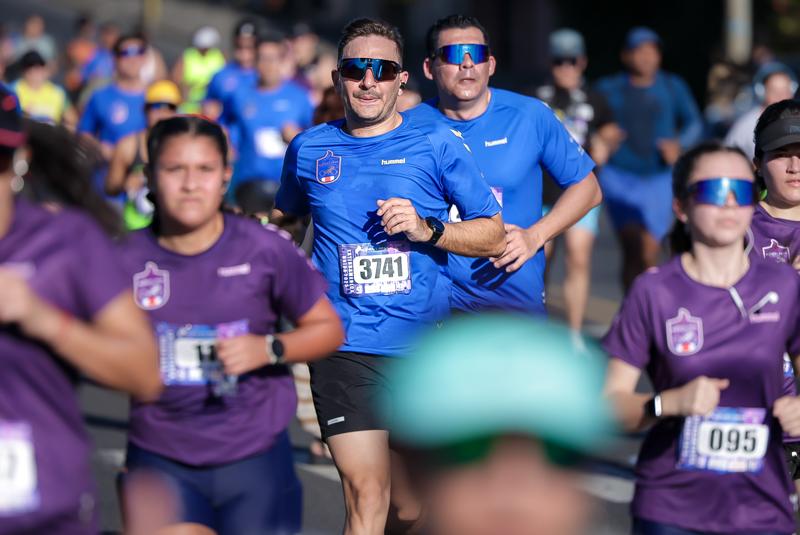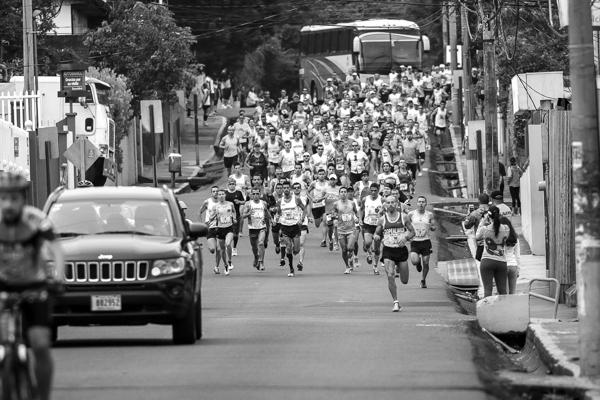
The highly anticipated Maratón Correcaminos is approaching, along with its shorter siblings the Half Marathon and 10k. All together, they will bring together this Sunday 5140 officially registered athletes: 1290 in the marathon, 3000 in the half marathon, and 850 in the 10k.
And although the marathon and half marathon courses look very favorable due to the predominance of downhill sections, the race is not easy. It will be vital to run with intelligence and design a good strategy if you want to arrive with enough strength for the most difficult stretch: the final 10k. "Just let loose on the downhill and then hold on," some say. The problem is that when going downhill, the impact on your muscles is much greater, and a downhill that's too fast could leave your legs feeling like stone for those final kilometers.
The marathon will start with 12 kilometers that are very flat under the cold and mist of a still-dark Cartago at 5 a.m. With no significant hills or downhills to break your rhythm, these first 12k are very convenient for settling into your target pace right from the start. For example, if you plan to finish in 4h15', your average pace should be 6:03 minutes per kilometer. Our recommendation is to run these initial 12k at that pace, which should feel comfortable. It's normal for your pace in the first kilometer to be a bit faster than planned, due to adrenaline and the rhythm of those running alongside you, but if you let yourself get carried away and run too fast, you could condemn yourself to suffer like never before for the rest of the race.
Everything changes at kilometer 12, when the big climb of Cerro del Ochomogo begins: four kilometers of uninterrupted, constant, and fierce ascent. In total you'll climb 138 meters above sea level over those 4k of Ochomogo, more than enough to break the steady pace that the first 12k flat sections had allowed. Don't despair, your pace will naturally slow down; concentrate on maintaining constant INTENSITY, not pace. Later, when you overcome Ochomogo you'll be at the highest point of the race and there will be no less than 17 kilometers straight of downhill, barely interrupted by two or three short hills.

This big downhill between kilometer 16 and 33 is great for recovering the pace lost on the Ochomogo climb and going a few seconds per kilometer faster than your average pace, but not much faster. An out-of-control downhill will result in heavy legs and great fatigue for the final 11 kilometers, which include the 2k climb through San José Centro and the final climb through Sabana Norte.
For half marathoners the recommendation is very similar: take advantage of the initial 10k of downhill to set a good pace, but not so much that you arrive without legs at the EPA sector in Curridabat, which is when the small hills and false flats begin and when you need the most strength to maintain your planned pace. The route is very favorable, with 203 meters of net downhill between start and finish, which should allow for good times, but again, it would be a mistake to think it's easy.
The 10k route is the least favorable, as it only has 9 meters of net downhill between start and finish. That is, it's practically flat on average, but the course is full of hills and downhills through San José. These are, of course, also the final 10k of the marathon and half marathon, and will definitely be the most difficult stretch of the course, beyond any fatigue you may have accumulated by that point. Maintaining a constant pace is almost impossible with so much up and down, so it will be important to concentrate and maintain constant intensity and let your pace naturally rise and fall with the changes in topography.
Each kilometer of the course will be marked, which will be a great help to know exactly which kilometer you're at. Marathon runners will have 14 hydration stations on the course, four aid stations, and three sponge stations to cool off. Half marathoners will have 7 hydration stations, and 10k runners will have 4. We recommend you review in detail the hydration and aid planHERE.
You can also see the detailed maps for each distance:
— RELATED: EVERYTHING YOU NEED TO KNOW FOR THE CORRECAMINOS.
— RELATED: 10 FACTS ABOUT CORRECAMINOS THAT ARE GOOD TO KNOW.