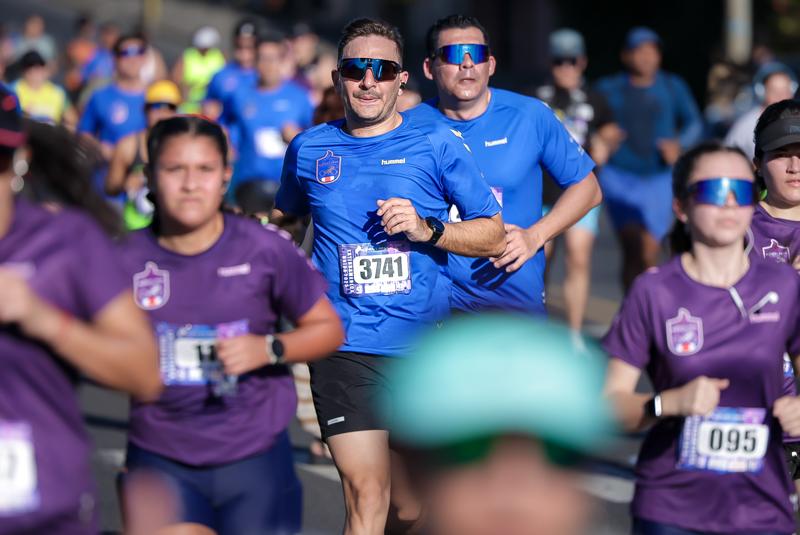
"The air is thick and hot, my pace has dropped, I can't maintain the speed I had and each stride becomes heavier and more difficult than the last. I'm barely halfway through the race and there's an unbearable haze in the air that won't let me breathe well, there's no water, I'm thirsty, I feel myself weakening and it's as if my muscles have run out of strength… I don't know how I'm going to make it to the finish line…"
Have you ever felt something similar? It's likely that if you've run a race in sufficiently hot and humid weather, you've experienced the terrible sensation of suffocation described in the first paragraph. And it's inevitable—performance in hot climates will never be as good as in cooler climates, so don't try to set your best 10k time at Sol y Arena, because you'll hardly manage it.
What you can do is minimize the negative impact that heat and humidity will have on your performance, for which we offer you the following tips:
Arrive well hydrated at the start.Hydration is directly related to your ability to lose heat and maintain good function. Your urine should always be clear and odorless. Two hours before the start, drink between 400 and 600 milliliters of water or sports drink. Also, bring a small bottle with 300-400 milliliters of water to the start in case you get thirsty just before leaving. If you don't get thirsty, pour it over your head—it will help you cool down.
Acclimatize. Optimal acclimatization is achieved by training for 7-14 days in the hot and humid climate where you'll be running. But this is impractical because no one is going to move to Puerto for two weeks before Sol y Arena. What you can do is train during the hottest hours of the day for the 15 days before. If you can only run at cool times due to schedule or other reasons, then during those 15 days before, wear a jacket while running. This will create an environment similar to the hot and humid climate, which will stimulate the adaptations that will allow you to run better, such as more abundant and diluted sweating, better blood distribution to muscles and skin, and lower body temperature at the same intensity.
Start easy. Do the first kilometers at a comfortable pace, without pushing too hard. If you feel good in the final kilometers you can always pick up the pace and make up the seconds lost at the slow start. This is better than starting fast and reaching the halfway point exhausted and without strength.
Wear minimal clothing. And what you do wear should be made of lightweight material that doesn't trap sweat, like modern sports clothing.
Wear a visor. Although it can be a great help to protect your face from the sun, a cap will make your head heat up more and reduce your cooling capacity. Better to wear a visor, which lets you block the sun while keeping your head uncovered.
Seek shade. In the moments before the start, try to expose yourself to the sun as little as possible.
Don't warm up. If the environment is hot, your body will be too. Don't jog the 10-15 minutes you usually jog before races, because you'll only wear yourself out. If you need some movement before starting, do a few short sprints and call it good. Remember that in such hostile climates, what you want to avoid is overheating.
Pour water on yourself. Take advantage of the water stations to spray water over your head and neck. This will help dissipate some heat and give you a feeling of freshness that feels great psychologically. (Ecological note: please keep the cup in your shorts, don't throw it on the ground, especially in races that are on the beach because cups end up in the sea).
Avoid protein. In the meal before the event, whether lunch or breakfast, avoid protein because it generates more heat and takes longer to digest. Prioritize carbohydrates and make sure to eat moderately (not excessively) about 3-4 hours before so you arrive at the race with digestion complete.
Be careful! Running in heat can be dangerous. If you arrive unprepared and also ignore the signals your body is giving you, you can suffer serious consequences and even death. But your body always warns you. If during the race you feel a weak pulse, nausea, dizziness, exhaustion, headache, or cramps, your body is possibly having trouble managing the heat. If you continue, you'll reach changes in consciousness and confusion, dry and flushed skin, rapid breathing, irritability, and beyond that fainting and coma. To avoid such extremes, listen to your body from the first symptoms, slow down, ask for water, and find a cool place to rest.
Don't be scared but do be careful. Thousands of runners take on running Tamarindo Beach Marathon, Sol y Arena, and other races in hot climates every year without suffering serious consequences. However, there are some who do end up fainting or with severe dehydration and sunburns.
To not be one of these, follow the advice we've given you and practice it beforehand in your training. Mainly arrive and stay well hydrated, run at a comfortable pace, and listen to the signals your body is giving you. After that, enjoy the beach, the people, and the pleasure of achieving one more goal…