Eight years ago I thought I was witnessing perfection in the form of a runner. It was Tirunesh Dibaba's Olympics, Beijing's, when she won gold in both the 5,000 and 10,000 meters. But beyond the golds, it was her exquisite running form that captivated my attention and left me speechless: a brutal pace carried by legs that apparently made no great effort judging by the imperturbable face of the Ethiopian, who practically glided across the Bird's Nest track as if two angels lifted her, one from each arm, while she broke her rivals one by one.
Dibaba's running form continues to captivate me to this day, when I saw her win bronze and achieve her best time in the fastest 10,000 meters in history. But the cameras barely focused on her. She was in fourth place most of the race, and the cameras only had room for whoever was in first place and the 50 meters that separated her from her immediate pursuer. That first place belonged to Almaz Ayana, another Ethiopian, who was on her way to breaking an almost impossible world record apparently with the help of two other angels.
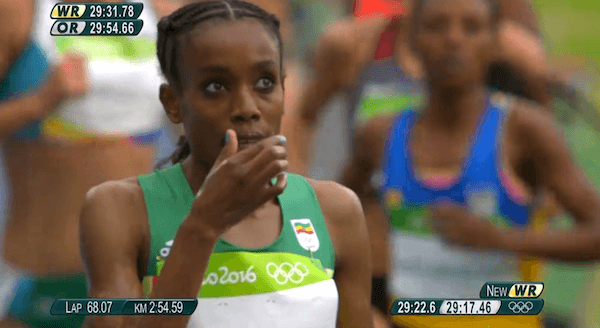
Just as Dibaba did eight years ago, Almaz Ayana ran almost in the air, suspended and showing no sign of effort. She flowed while we all waited for the moment when she would slow her impossible pace, because it had to happen sooner or later. But Ayana remained imperturbable, dominant, strolling across the Rio Games track as if it didn't cost her to run at 2:56 minutes per kilometer and shatter the previous record by more than 14 seconds. She crossed the finish line, breathed barely as if she had just come back from running an errand at the corner store, and proceeded to celebrate her feat without showing any signs of fatigue. And here I am, winded just from getting up from my chair...
These are the numbers from today's race, including a graph with the split for each kilometer (the split is from the runner who was in first place, so the first 5 kilometers are Alice Aprot's time, but Ayana was always right on her heels so it doesn't vary much).

• Ayana ran the first half in 14:46 and the second in 14:31, which confirms, once again, that running negative splits (the second half faster) is the best strategy.
• Her average pace per kilometer was 2:56 minutes. Do a little exercise: go to the La Sabana track (or whichever is closest to you), and run one lap (400 meters) in 1 minute and 10 seconds, or at least 200 meters in 35 seconds. That was Ayana's pace for 25 laps around the track.
• Seven years ago no woman had broken 30 minutes; today four women achieved it (Ayana in 29:17, Cheruiyot in 29:32, Dibaba in 29:42, and Aprot in 29:53).
• 17 competitors improved their personal record.
• Ayana ran the last kilometer in 2:54.59.
• This was only Ayana's second 10,000-meter race. The first was a month and a half ago and she finished in 30:07.
• No Costa Rican (men included) has come close to that mark in more than a decade, with the exception of Álvaro Sanabria who, living in the United States, managed to run 29:39 in 2012.