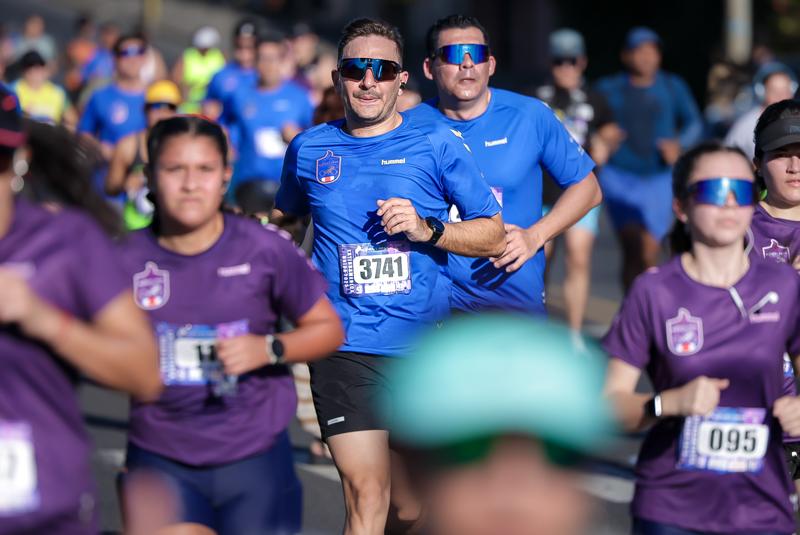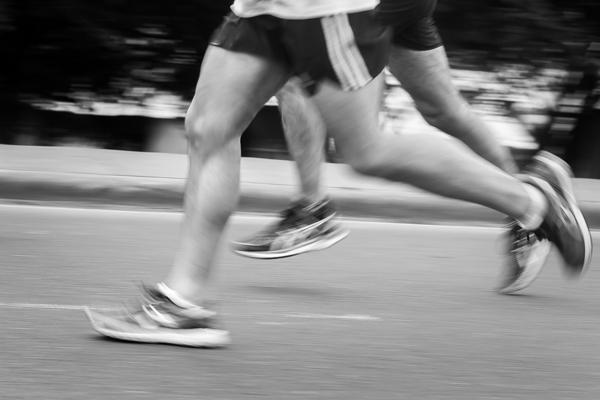
There is no such thing as working too much on technique. That's why we're giving you six new keys or mental tricks that will help you improve your running technique just by actively thinking about them during your workouts. The first six keys we had given you can READ HERE.
Remember that concentration and discipline are required for the keys to be effective. The improvements achieved with these keys don't come overnight, and you need to practice them over hundreds and even thousands of strides.
Driving the thigh: Concentrate on driving your thigh forward with a bit more force. This forward and upward force will generate a balancing reaction downward and backward in the other leg just as it makes contact with the ground. This key will give your stride more symmetry and rigidity.
Relaxed feet: Concentrate on running with relaxed feet. Keep striking the ground hard, but use your upper leg muscles to generate this force while keeping your feet relaxed. This allows your feet to absorb and transfer impact forces in a way that minimizes stress on certain tissues and increases the amount of elastic energy for you to store and use again.
Glute squeeze: Right at the instant your foot makes contact with the ground, contract the hip and glute muscles on that side of your body, and keep them contracted throughout the entire ground contact phase. This key will give your hips, pelvis, and lower spine greater stability, and will minimize unnecessary asymmetrical rotations in that area.
Feeling the symmetry: Direct your attention to a specific part of your body, or your stride, on both your left and right sides. Concentrate on how your arms move, the forward movement of your legs, the moment of ground contact, the push-off, or something else. Compare the sensation on your left side with your right side. If there are differences, adjust your position so that you eliminate the difference, or at least minimize it, so that the side that felt less natural resembles the other more. Obviously, this key will help you reduce asymmetries in your stride.
An axis between your knees: Imagine there's an axis between your knees, like the axle of a wheel. Imagine there's something separating your knees and pushing them a couple of centimeters farther apart while you run. This will help you engage your hip flexors and external rotators, and will prevent your thigh from rotating internally (a common cause of injuries).
Running against a wall: Imagine there's a wall right in front of your nose and it moves along with you as you run. Your knees or feet would repeatedly hit the wall unless you shorten your stride and place your feet right under your hips, instead of in front of your body. Leaning forward slightly from your ankles will also give you more room to drive your thighs forward without your knees hitting. This key facilitates a more compact stride by correcting overstriding.
Source: Matt Fitzgerald, Brain training for runners. 2007.