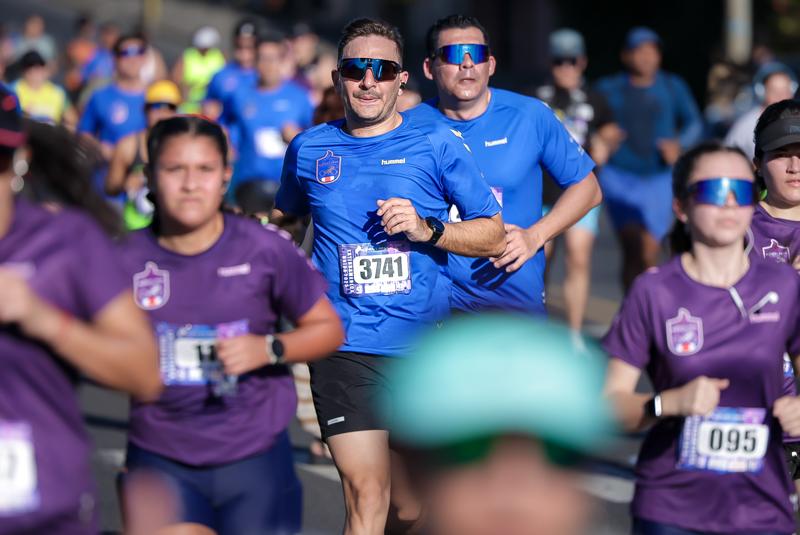
If you want to improve your times, you definitely need to run faster. But not just during the race—the key is to run just as fast or faster in (some of) your training sessions so that on race day you can maintain the pace with greater comfort.
Speed, and even more so, the endurance needed to sustain that speed for a long time, is not something that comes easily. It requires a lot of work, discipline, and effort in training, but if you do it right and stay consistent, your best times will start to come. Here are some keys to running faster:
1. Run more. It's an interesting first tip. We're not saying "run faster"—we're simply saying "run more", even if it's at an easy pace. It turns out that among the many factors that influence performance, volume is what's most associated with better performance. So if you're currently running about 30 kilometers per week, try to increase to 50 or 70 kilometers per week and you'll definitely see an improvement in your performance and run those races faster. Be careful, though, because it's not as simple as saying you'll increase your mileage and that's it—it should be a gradual process and you need to allow your body to adapt little by little to the new volume.
— RELATED: THE ART OF RUNNING AT THE RIGHT PACE
2. Increase your maximum oxygen consumption. This requires running at a very high intensity, which can be around 90-95% of your maximum heart rate. Training sessions aimed at increasing your VO2 max typically have a 1-1 interval-rest ratio. That is, if you run four minutes at that high intensity, you rest for four minutes before starting a second repetition. A good workout to start with is running for 15-20 minutes alternating one minute of very hard effort with one minute of easy pace as recovery.
3. Improve your running economy. This means you'll be able to run at the same intensity using less energy, which in turn will allow you to run for longer at paces that were previously impossible for you to sustain. The more you run, the more your economy improves, so it relates to the first tip. But you can also improve your running economy by starting a strength training routine and doing tempo runs. Both types of training will make your neuromuscular connections more efficient and make you more economical when running.
— RELATED: STRENGTH TRAINING AND RUNNING; THE ORDER OF FACTORS DOES MATTER
4. Work on your mind. Confidence in yourself, the use of positive words during training and competitions, and visualization will help you face the pain in races and will allow you to maintain a strong pace for longer. Visualization is an exercise in which you reproduce in detail in your mind all the aspects you'll face in the race, from before the start to the smells and sensations you'll have while running. This will help you be prepared and you'll know how to react to different scenarios.
We insist that gaining speed is not something that happens overnight. You must be consistent in your training and add the variables we've mentioned to overcome your current limits and achieve new personal records in your preferred distance. Let's go!