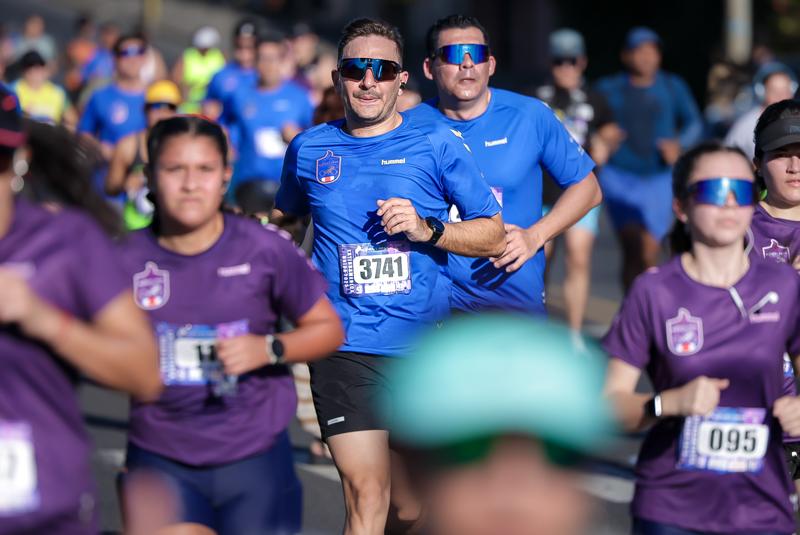
Experienced runners often naturally synchronize their breathing rhythm with their running pace, which allows them to maintain better control over the correct intensity at which they should run. With a little practice and concentration, you too can synchronize your steps and better master intensities during races or training.
The frequency at which you breathe is an indicator of the intensity at which you are running; the faster you run, the faster you need to breathe. If you cannot maintain a 2-2 breathing pattern in the first kilometer of the race, you are going too fast, and you will probably suffer for it later.
That's why, if you can control your breathing rhythm, you will be able to run at the optimal speed, neither too fast nor too slow. Some rhythms are, from highest to lowest intensity:
1-1
2-1
2-2
3-2
3-3
The numbers represent steps. For example, in 1-1 breathing, you inhale while taking your right step, and exhale while taking your left step. In 2-1, you inhale during 2 steps (right-left) and exhale during just one step. And so on.
The best runners typically use 2-2 when competing (they inhale during 2 steps, exhale during 2 steps). It's an ideal breathing rhythm because it allows a good amount of air to move in and out of the lungs with each breath. It's also a rhythm that aligns well with the 75-90% effort level where we spend most of our races.
2-2 is the rhythm recommended for a 10k race. If you started too fast and are breathing at 2-1 or 1-1, slow down to a 2-2, which is much more manageable and will allow you to maintain that speed for longer.
In the final third of the race, allow yourself to accelerate to a 2-1 breathing pattern, and even to 1-1 for the final kick. The problem with 1-1 rhythm is that it's too fast (like panting), and it leads to barely shallow breathing that doesn't allow your lungs to ventilate properly. Many deceive themselves thinking that the faster they breathe, the more air reaches their lungs. The truth is that when breathing frequency increases as much as in 1-1, the depth of breathing decreases, and the net result is that less air enters the lungs. That's why it's only recommended in the final meters.
To have control over your breathing rhythms, you must practice. During easy training, a 3-3 rhythm is optimal. In fact, if you cannot sustain a 3-3, you are probably going too fast for an 'easy' training session. You can try a 4-4 if it feels comfortable, but it's so slow that sometimes it doesn't allow you to clear all the carbon dioxide from your lungs.
Another reason to pay more attention to how you breathe is side stitches. When you breathe too fast, you're more likely to get a side stitch, or it may worsen if you already have one. The next time you feel these sharp pains in your abdomen, try breathing at a 3-3 or 4-4 rhythm; it might help.
In general, try the different rhythms to see which one suits you best according to the intensity you're maintaining. Practice them; at first it's not easy, but over time you'll synchronize almost unconsciously.