And there I was. Sitting in the middle of the road on Cerro Chirripó, holding both my legs with my hands and screaming uncontrollably from the pain. With every muscle in my legs cramped, I still had 11 kilometers of torture left until the finish line.
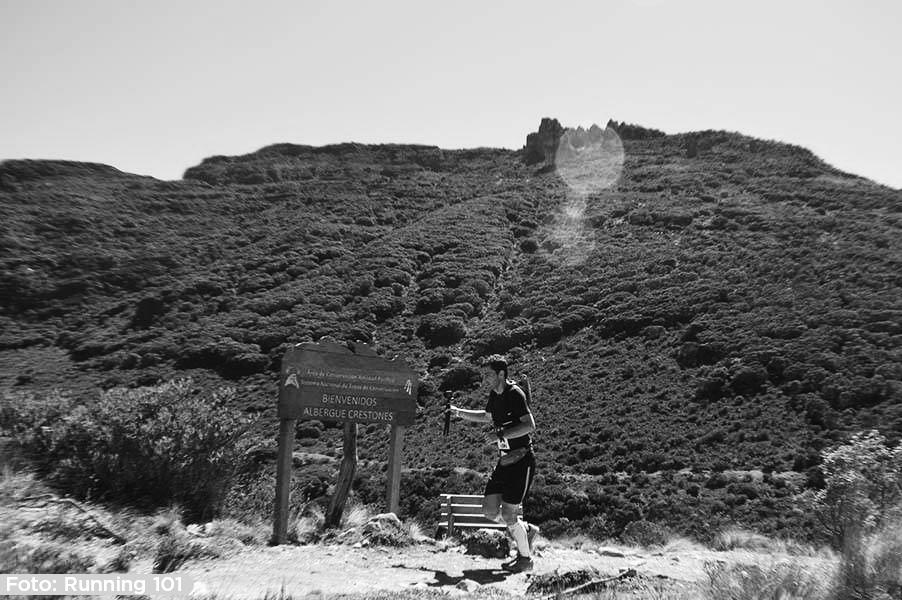
The Chirripó Race is perhaps the most well-known trail running event in Costa Rica, and without a doubt one of the most difficult, or perhaps the most difficult of all. The 34 kilometers of the race offer no mercy at any moment; you're either climbing hills with up to 19% incline on trails full of sharp rocks, or you're descending down the same way. Every muscle in your body must strain to the maximum to climb 2050 vertical meters from the Salón Comunal de San Gerardo de Rivas (1350 m.a.s.l.) to the Albergue Crestones (3400 m.a.s.l.), and then turn around to descend them.
So really, the 34k of the Chirripó Race is equivalent to running about 50 or 55 kilometers on road (more than a marathon), and with the added danger of tripping at any moment and smashing your head into pieces against a rock. And the thing is, the road to Chirripó isn't made of dirt and leaves—it's made of rocks! To put it in perspective, Juan Ramón Fallas, the king of Chirripó, holds the race record with a time of 3h04'04'' for the 34k. That same Juan Ramón has run several road marathons (42k) in less than 2h30'…
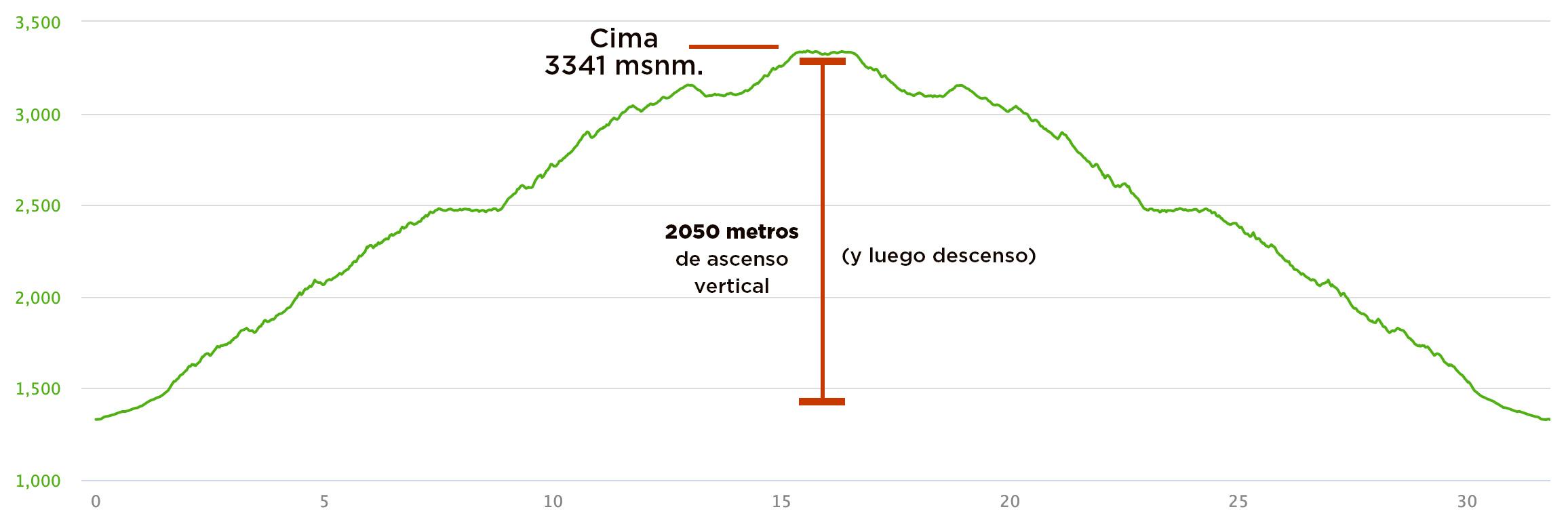
And there I was, who had never run more than 25 kilometers in my life, on road or on trail, suddenly throwing myself into the 34 most difficult kilometers in the country. And well, it hadn't gone so badly: I managed to complete the climb in less than three hours, which was my best-case estimate, and I was getting into the rhythm of the descent. Yes, just after I turned around at kilometer 17, I felt like an electric eel had discharged a thousand volts into my sartorius muscle (it runs from the hip to near the knee, and works a lot when you're going uphill). But after some self-massage and a couple of minutes of easy walking, it let me continue on the condition that I wouldn't push it with hard climbs again. All I had to do was tackle the few remaining short climbs limping, putting the effort into my left leg, and that was it.
You really don't know what pain is until you trip on an insignificant little rock at kilometer 23 of the Chirripó Race and every single muscle in your legs decides to perform an electric choreography and contract simultaneously. You make adjustments in the air to avoid the fall and… well, my muscles weren't in the mood for abrupt changes of direction after the beating I'd been giving them for more than three hours, so when I tried to move them to avoid the fall they rebelled with fury.
We're talking about both gastrocnemius muscles (the calves, that is), the soleus muscles (also calf, a bit lower), and the quadriceps (four large muscles on the front of the leg) of BOTH legs, as well as muscles I didn't even know existed, all cramping in the same electric shock, and me there sitting, screaming in pain and watching with eyes wider than normal as the skin became disfigured before the muscles suddenly turned into electrified stones.
Three runners caught up with me in the two or three minutes I was on the ground, politely asked if I needed help, and I thanked all three and asked them to continue on their way. I mean, I didn't want to be a bother to anyone and besides, it's not like you can call a taxi to pick you up in the middle of Chirripó… Little by little the cramping eased and my muscles were left stiff as stones. As best I could, I tried to get up; it was like I had my legs in a cast from my hip to my ankle, but holding onto the rock wall I pushed myself up with my arms until I was standing. At that moment, I understood that the 11 kilometers I had left to reach the finish line I would have to run not with my body, but with my mind. Like levitating, if you will, but without actually levitating. I focused on the right angle to support myself so that my calf, quadriceps, or both wouldn't cramp again. If there had been a possibility, I wouldn't have hesitated to call a taxi to pick me up. But the Chirripó trail doesn't allow for that kind of privilege.
I'm not going to make this story longer than it needs to be. I walked, I sat down, I tried to run easy, I walked again, I sat down again and, in short, I pushed through every single one of those 11 thousand meters that were left from the moment I tripped on that rock. In the end, beaten and frustrated, I made it to the finish line. It's hard to explain the feeling of happiness that fills you when you cross that finish line arch. The relief of having survived a war that I had gotten myself into, and in which I was my only enemy. It's the worst kind of war, the one you can only win by defeating yourself.
Chirripó gave me a slap and left me with a lifelong lesson: you can have the audacity to challenge its 34 kilometers, but no one comes out of there being the same person who went in.