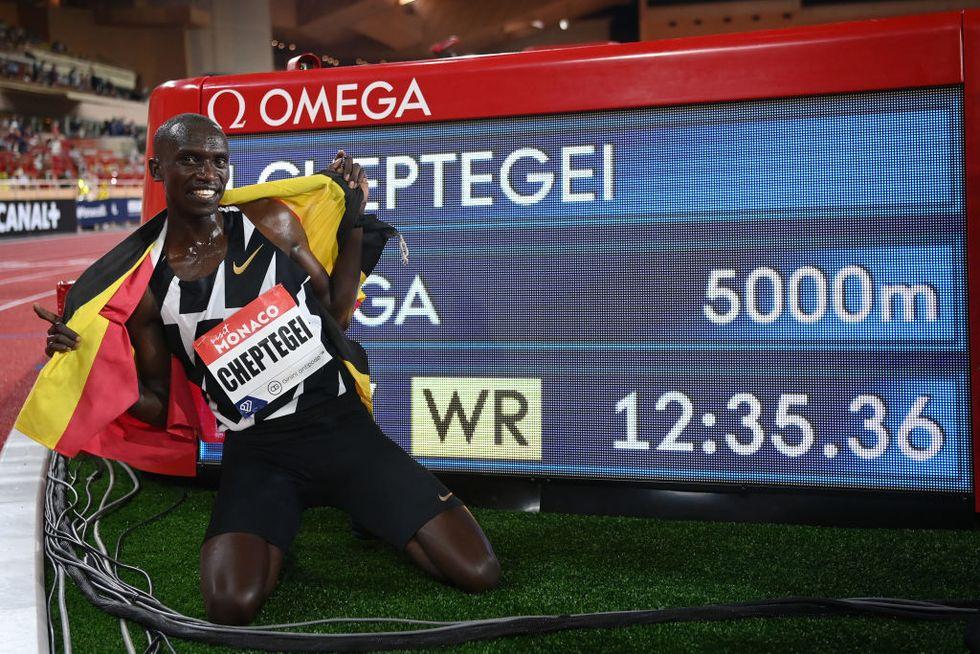
The day when legendary Kenenisa Bekele set the world record in the 5000 meters flat, Joshua Cheptegei was just a 7-year-old boy starting school in his native Uganda. And Bekele's record was so dominant that for 16 years no one could get within 5 seconds of it. It was untouchable. No one even dared to try. That is, until last Friday.
That day Cheptegei, now 23, announced to the world that he was going for the record. He felt confident he could run 5000 meters in under 12:37.35. With a personal best of 12:57, almost 20 seconds slower, the feat seemed too ambitious. Who is he to announce it so boldly?
Well, Cheptegei is no novice, nor are world records foreign to him. In February of this year (2020) he achieved the world record for 5k road (12:51), in December 2019 he had achieved the 10k road record (26:38), and in 2018 he had done the same with the 15k record (41:05). That, in addition to being world champion in Cross Country and 10,000 meters flat in 2019, a double that only one other man in history had achieved in the same year; ahem, a guy named Bekele.
So when Cheptegei says he's going for a record, you shouldn't take it lightly. The guy also has immense ambition. "I always tell my coach that "I want to become the greatest distance runner of all time". I believe I can do extraordinary things, so this (5000m record) is definitely a realistic goal," he said in an interview before his race.
And it certainly was. He ran like clockwork, even more precise when his pacemakers faded and left him alone against the wind, the clock, and the 26° heat. The last 6 laps on the track don't differ by half a second from one another. If we set aside the hundredths, this is how Cheptegei's 12 laps on the track look: 60, 61, 60, 60, 61, 60, 60, 60, 60, 60, 59, 59. More perfect would be difficult. It's as if he had a light marking the pace he needed to keep. Wait a moment, he did have one.
Little green lights lit up on the track rail at world record pace. This is a new technology approved by World Athletics (formerly IAAF) called Wavelight Laser Technology, which has entered with some controversy due to the obvious advantage it offers athletes, especially when running at a specific pace like when attempting a world record. Bekele didn't have this help in 2004, and therein lies the complaint of many.
But put the rest of the pack to run with the light and see if they can keep up the pace. Only Cheptegei stayed there. He and his DragonFly, the track equivalent of the famous VaporFly shoes that are said to have helped Kipchoge break his marathon records. But sport evolves and so does technology. Records are made to be broken and only the most prepared can achieve it. Bekele himself will probably run with his VaporFly at the next London Marathon, just as he did when he came two seconds short of breaking the record at the last Berlin Marathon.
"It took a lot of mental work to stay motivated this year because so many people are staying home, but you have to stay motivated," said the Ugandan after finishing in 12:35.36, lowering Bekele's mark by almost two seconds. "I challenged myself, and I had the right staff with me, the right coach. And although I normally live in Europe, the fact of spending this time in Uganda with my family was really good." As soon as the Olympic Games were canceled in March of this year, Cheptegei's objective immediately changed to pursuing the record.
The big question is, what else can he achieve? Being more of an endurance runner than a sprinter, the 5000 meters record presented itself as the most challenging for him. His next goal will be to break the 10,000 meters record, which also belongs to Bekele and has for 16 years, and for which he seems even better prepared given his strength in long distances. "If you believe in something, anything is possible. Breaking a world record was something really difficult, but when you know the right path, it's not so difficult anymore. The next challenge is to pursue one or two more records, (if I achieve it) I would be the happiest person in the world," he declared.
Just two years ago, Cheptegei was the protagonist of one of the most impactful and sad moments an athlete can experience. At the 2017 World Cross Country Championships (CC), held in his native Uganda, Cheptegei was leading the race in front of an euphoric crowd chanting his feat with just 1 kilometer to go. He was about to become the first Ugandan to be crowned world CC champion and had a 13-second lead over second place when his body suddenly abandoned him and reduced him to an unstable, drunken trot.
After that painful episode, Cheptegei rose up and became Cross Country world champion in 2019, redeeming himself from that tragedy and giving his country the title for the first time.
Facts and curiosities.
Cheptegei's last 3 races have ended with 3 world records: WR 10k road in December 2019 in Valencia (26:38), WR 5k road on February 16 in Monaco (12:51), and WR 5000m on August 14 also in Monaco (12:35.36).
Only 4 athletes in history have run under 12:40 in 5000m. Cheptegei, Bekele, Haile Gebrselassie, and Daniel Komen.
There is only one synthetic tartan track in all of Uganda. Cheptegei trains on an uneven grass "track" that measures 415 meters.
He ran the last 200m in 29.5 seconds, the last 400m in 59.32, and the last kilometer in 2:29.11.
The average per kilometer was 2:31.
At that pace, he would run a marathon in 1h46'14''.
And 10k in 25'10''.