Exactly how much liquid to drink before and during a competition has been a much-debated topic among runners and experts around the world for a long time. And although no consensus has been reached, the (correct) answer may lie within each of us.
"Two days before, drink plenty of water… as much as you can so you arrive well hydrated at the competition; at least about eight glasses of water but if you can drink more, even better, and the same day too, drink plenty…"
Does this advice sound familiar to you? I'm sure it does. For some time now, dehydration has been the runner's worst enemy and is blamed for almost all the problems that can happen during a race. This has caused many to panic about dehydration and drink water abundantly during the days before, often following the advice of a coach.
The truth is that much of what has been said about dehydration is a myth. Humans, like most mammals, are designed to function in a state of moderate dehydration, which is later corrected by eating and drinking. And contrary to what the statement in the first paragraph suggests, humans do not have the ability to store liquids and minerals to compensate for a future deficit.
Since we don't store liquids for the future, it's useless to drink continuously during the 12-24 hours before a competition. Drinking excess liquid will simply result in more trips to the bathroom (which if it's at night disrupts our sleep, with the negative consequences that brings for arriving rested at the race), and more loss of sodium and potassium in the urine.
The best indicator to know if you are well hydrated is your urine. If your urine is scanty, dark, and has a strong smell, it's a sign of dehydration. On the other hand, if you urinate frequently, with a clear color and no smell, you are well hydrated.
To avoid drinking too much, simply listen to your thirst. Thirst is an extraordinary physiological mechanism that responds to internal indicators that tell your brain there is an imbalance in the concentration of body fluids, and then we feel thirsty and drink liquid to return to the optimal state.
Many defend the thesis that if you feel thirsty it's already too late, and that therefore you should avoid feeling thirsty by drinking liquid constantly, even if your body doesn't ask for it. But this is ignoring your body's signals and could create a state of overhydration that would actually harm performance. But if there is a specific moment to follow that advice, it's at the start of a competition. Right at the starting line, it would be inconvenient to feel thirsty, since there is no opportunity to hydrate at that moment and there won't be until 15 or 20 minutes later at the first aid station.
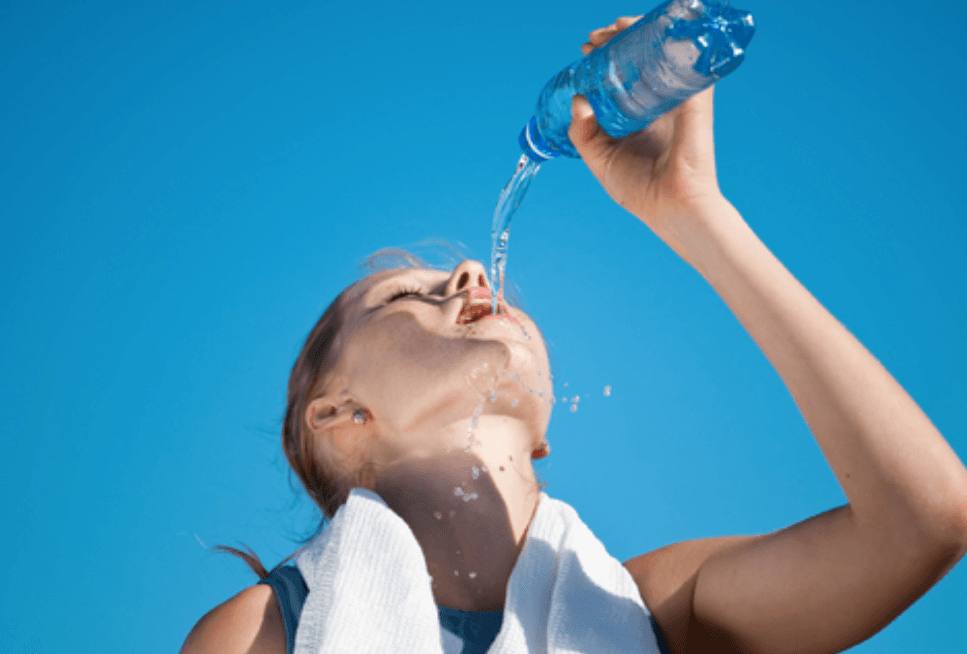
To avoid this, drink water or a sports drink to satisfaction two hours before the race (this is because it takes 1-2 hours to fully absorb the liquid). To be safe, you can bring a small bag with 300-400 milliliters of water in case you get thirsty minutes before the start of the race. If you didn't get thirsty, you can pour that water on your head or neck to cool off, which will be especially useful in races with hot weather like those held in the coastal areas of the country.
Another myth is that you should drink during the race as much liquid as you lose. For this they recommend weighing yourself before and after a workout to calculate the amount of liquid lost. If you lost 1.5 kilos in an hour, you know that in the race you should drink 1.5 liters per hour to stay well hydrated.
This is absolutely false. It is well proven that athletes with the best times in a marathon are also those who lose the most weight during the event, that is, the most "dehydrated." This responds to physiological reasons that have not yet been fully explained. The truth is that runners who drink ad libitum (at pleasure, as they feel like it) drink half or less of the weight they lose, and that seems to work quite well for the elite.
Setting aside high performance, no study has shown that drinking more water than you would ad libitum results in better performance. Rather, it's likely to cause bloating and gastrointestinal discomfort and harm performance. Generally ad libitum consumption is around 200-500 mL per hour.
No matter how much you wanted to drink as much liquid as you sweat, as some recommend, it's impossible, because the rate of gastric emptying during high-intensity exercise (like in a race) hardly exceeds 700 mL per hour, while you easily sweat more than a liter per hour, especially in hot and humid climates.
On the other hand, not all the weight lost during exercise is due to dehydration. There is a percentage (it's not known exactly how much) that is due to the water contained in the carbohydrates that are burned. This could be an important percentage and would also explain why ad libitum consumption is always less than what is lost through sweat.
In summary, we make the following recommendations to you:
During the days before the event (and always, really) drink water following your thirst and check the characteristics of your urine to know if you are well hydrated. And what happens if I drink according to my thirst and the urine shows signs of dehydration? It happens that some people, if they follow their thirst, simply would never drink water or would drink very little. In that case it's likely that due to a long history of bad habits they have unconsciously suppressed the optimal regulation of liquids through thirst, or perhaps when they feel thirsty they drink inadequate liquids like sodas that satisfy thirst but don't hydrate optimally. In that case, go by the color of your urine and drink enough liquid to maintain clear, odorless urine, avoid sodas or other drinks made with artificial substances. As much as possible, satisfy your thirst with water.
Two hours before an event, especially if it's in hot weather, make sure to drink enough liquid to arrive well hydrated at the race. Generally about 500-600 mL is enough. Then bring about 200-400 mL in a small bag in case you get thirsty just before the start, and if you don't, you can pour it over your head, which will help you stay cool in the first kilometers.
During the event drink water ad libitum. If you drink too much water and the event lasts more than four hours (as happens in a marathon for most runners) you can suffer from hyponatremia, a condition that causes low sodium concentrations in the blood, and that can cause death. In short races this won't happen to you, but you could get too full which would cause you discomfort and harm your performance.
Staying well hydrated is vital to achieve good performance in training and races as well as to prevent your body temperature from rising too much, especially in hot and humid climates. But this is not a license to ingest liquids without limit and without any control. Instead, develop healthy habits and learn to read your body's signals.
Sources: McArdle, Katch and Katch, Exercise Physiology (2007); Noakes, Lore of Running (2001); Daniels, Daniels Running Formula (2005)