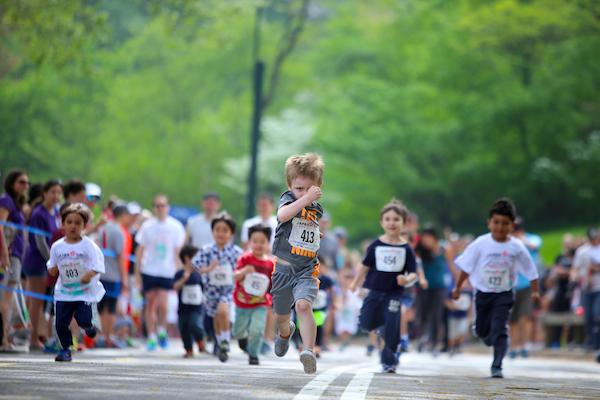
It's common to see children running popular 10-kilometer races on weekends, even some under 10 years old. Is that good or bad? At what age should a child start training to become a good athlete? What role should parents play?
We'll tell you two things emphatically:
1- Involving your child in sports is the best thing you can do.
2- Pressuring them to compete, win, or perform at their maximum is a very bad idea.
From the moment your child learns basic movement patterns like walking, running, and jumping, you should motivate them to engage in plenty of physical activity, as this will lay the foundation for a healthy and active lifestyle in the future. After age five, it's common for children to feel the desire to enter races or accompany their parents while running. The question is, how much running is healthy for children?
It's relatively simple or relatively complicated, depending on how you look at it. Even a five-year-old could be physiologically prepared to run a marathon (there have been at least a couple of very controversial cases worldwide). There is no table or precise guidelines that say: at this age, they cannot run more than this distance. Everything is relative, because we're all different, we adapt differently to training, and we have different motivations.
— RELATED: THE GREAT BENEFITS OF EASY-PACE RUNNING
If the child expresses the desire to run, on their own initiative and without any pressure from parents, peers, or 'coaches,' that's a good sign and you should encourage their desire. Does this mean that if your 8-year-old tells you they want to run a marathon you should allow it? In that case, simply celebrate their initiative and let them start experimenting with shorter distances and races. They will know when it's enough, as long as—and this is very important—there is no external pressure and they're not doing it to please someone like mom or dad.
You have to be very careful with your words when motivating your child to exercise. Phrases like 'my child is a champion,' 'they're going to win that race,' 'they're the best in their class,' etc., put unnecessary pressure on children and can have negative effects on how they view sports. It's better to speak in terms of 'doing their best' and 'enjoying the competition' rather than always talking about winning and being the best. Before age 12, sports should be seen as something purely recreational, socio-emotional, and enjoyable, not competitive.
But if your child tells you they want to be an Olympic champion, or the best in the world, shouldn't they train from a very young age? There are specific sports like gymnastics, tennis, and to some extent swimming where specific training at early ages could be important for future professional performance. However, in the specific case of athletics, more intense and specific training can start at 16 or 18 years old and still produce world champions; examples abound. Just as there are plenty of examples of young talents who were pushed so hard in their childhood-adolescence that they later lost interest or the ability to handle high training loads, and let their talent fade away.
Here are some general guidelines to help you guide your child down a good sports path:
Before age six: Motivate them to play and be physically active through play. Everything should be play, fun, and pleasure.
Ages 6 to 10: This is an excellent age to spark their interest in sports, emphasizing having fun and learning basic skills. At these ages, children don't yet have the hormones needed to produce major physiological adaptations to training, so it's not a good time to put them on strict training regimens. Up to this point, everything should be fun.
Ages 11 to 15: Encourage them to participate in many sports and to learn proper techniques. Many children at this age can already cover very long distances and in some cases even a marathon. The key is, we insist, that it be their desire and that the process be carried out without any pressure or obligation.
Ages 16 to 18: At this age they're ready for higher training loads and specialized training, including weights and intense interval and long-distance sessions. Still, you should remember that they're not yet an adult and should not be subjected to adult-level loads or the pressures of prolonged competition.
If you give your child the appropriate stimuli, sports will generate positive attitudes and a healthy lifestyle in them, strengthen their ability to interact with others by sharing emotional and physical experiences, and help them develop a positive perception of their body image. The key is to allow them to set their own goals and experience the sensations of covering greater distances or at greater intensities.
In summary, if a seven, eight, or ten-year-old child is already running 10k or even more, it's not necessarily bad. If they're only running 1k, that's not bad either. The only thing that's bad is forcing them, pushing them, pressuring them, demanding from them. But if running is a pleasure for the child, it makes them happy, and they have fun, there's no reason to put distance limits on them. They'll figure out on their own how much is enough, and their body will also take care of sending warnings if they're overdoing it. Pay attention to them, support them, and let them be happy through sports.
— RELATED: WHY RUN A MARATHON?