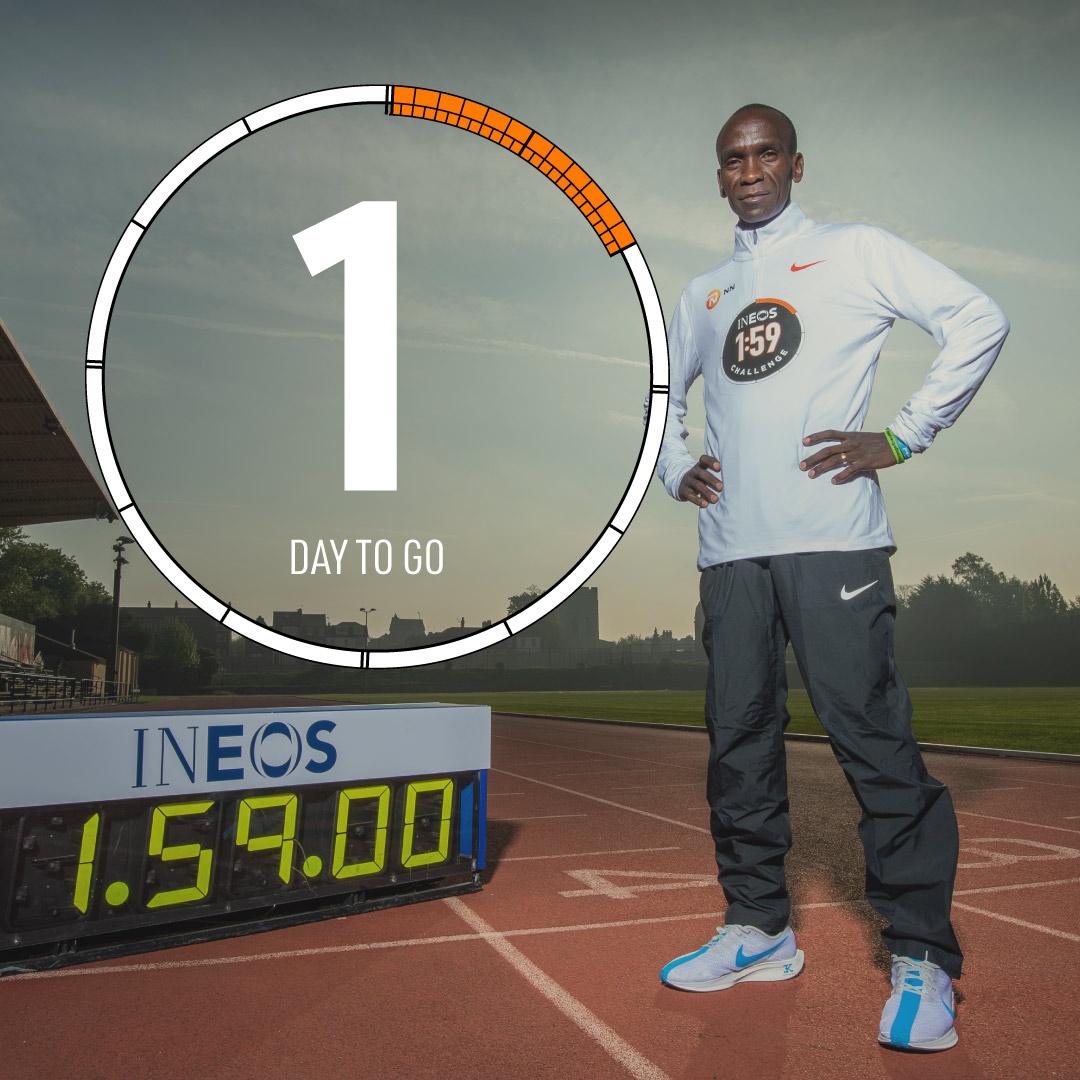
Tomorrow could be a historic day for world athletics. It could be, perhaps, for all of humanity, because tomorrow one of ours, one of those who walks on two "legs", will attempt the unprecedented feat of running a marathon, that is 42.195 kilometers, in less than two hours.
The chosen one, as if it were an athletic version of Matrix, is the greatest marathoner in all of history. A black Neo, lean and sublime when he launches one foot in front of the other to complete the cycle we call running. The one who seems to levitate over the asphalt as if moving at 21 kilometers per hour for two full, consecutive hours required no greater effort. The one who has said a thousand times over what he will attempt to prove tomorrow: that "no human being has a limit".
This is Eliud Kipchoge, Kenyan as always, holder of the current world marathon record with an astounding 2:01:39 achieved last year in Berlin, reigning Olympic champion and undefeated in his last 10 marathons.
Widely considered the greatest marathoner of all time, his strongest weapon, though it may seem strange, is not his legs or the speed of his heartbeat. It is his mind.
He maintains a relentless and non-negotiable daily training routine that extends 365 days each year, and lives a simple life at 2700 meters of altitude in Eldoret, Kenya, which consists of running, spending time with his family and sharing with his friends.
Background.
This is not the first time someone has attempted to break the two-hour barrier in a marathon. Two years ago, in 2017, Kipchoge himself, along with Eritrean Zersenay Tadese and Ethiopian Lelisa Desisa, attempted for the first time to break two hours on the car racing circuit in Monza, Milan, at that time for the project that Nike called Breaking2.
Even Nike's own engineers knew that even getting close to two hours was a far-fetched odyssey, but it's Nike and the marketing strategy for its brand and its Vaporfly 4% shoes would be magnificent anyway. However, when Kipchoge stopped the clock at 2:00:25 in that race, everyone looked at each other and thought: "maybe, after all, it might be possible".
And like a splinter that lodges in your foot and resists coming out, Kipchoge has kept his sights set on the goal of being the first to break the legendary two-hour barrier. Three marathons and a world record later, he will have his second chance, acknowledging that he is much better prepared than back then, now training 200 to 230 kilometers per week (an average of 32.8 kilometers each day).
This time the commercial brand that wants to etch its name in history is INEOS, the same as the famous cycling team that just hired Andrey Amador, by the way, the most powerful and winning team of the last decade in world cycling. The INEOS 1:59 Challenge will attempt to break what they have called "the last barrier of modern athletics", a barrier as famous as the one broken byRoger Bannister65 years ago when he was the first to prove to skeptics that a human being could indeed run a mile in less than 4:00 minutes without dying in the attempt.
What, how and when?
The race will be tomorrow, Saturday, October 12 in Vienna, Austria, on a 9.6 kilometer circuit that is absolutely flat, surrounded by trees, with pure air and a crowd of up to 250,000 people expected to show up in support (a big difference from Monza, where there were only a handful of people cheering). The temperature will range between 7º and 14º degrees Celsius, humidity at 80%, with no rain or significant wind. Everything is absolutely planned and synchronized so that when Kipchoge starts running he has perfect conditions. Everything will start on Saturday at 00:15 (Costa Rica time), and can be watched live on YoutubeHERE.
But what is the importance of this feat?After all, the time that Kipchoge achieves, just like the one he achieved in Monza two years ago, will not be officially recognized by the IAAF because the regulations prohibit several of the things that will be done to help Kipchoge, including the rotation of more than 30 "pacemakers" (runners who protect him from the wind and help him maintain the desired pace).
But the importance does not lie in the official recognition of the record, but in the value of redefining human capabilities, of making true the signature phrase of Eliud, his famous "no human being has a limit". Though undoubtedly romantic, the phrase is loaded with teaching for anyone willing to open their eyes and see that their limits are nothing more than imaginary barriers that willpower can bend and redefine the moment you realize and internalize that you truly can do it. Neo stopped dozens of bullets with just his gaze, Kipchoge ran 42k in less than two hours, what can't you achieve?
"This is about leaving a legacy. Breaking the two-hour barrier is crucial for me. I want to show the world that when you believe in something and have faith in what you are doing, you will achieve it, whether you are a runner, a teacher or a lawyer.". Eliud Kipchoge.